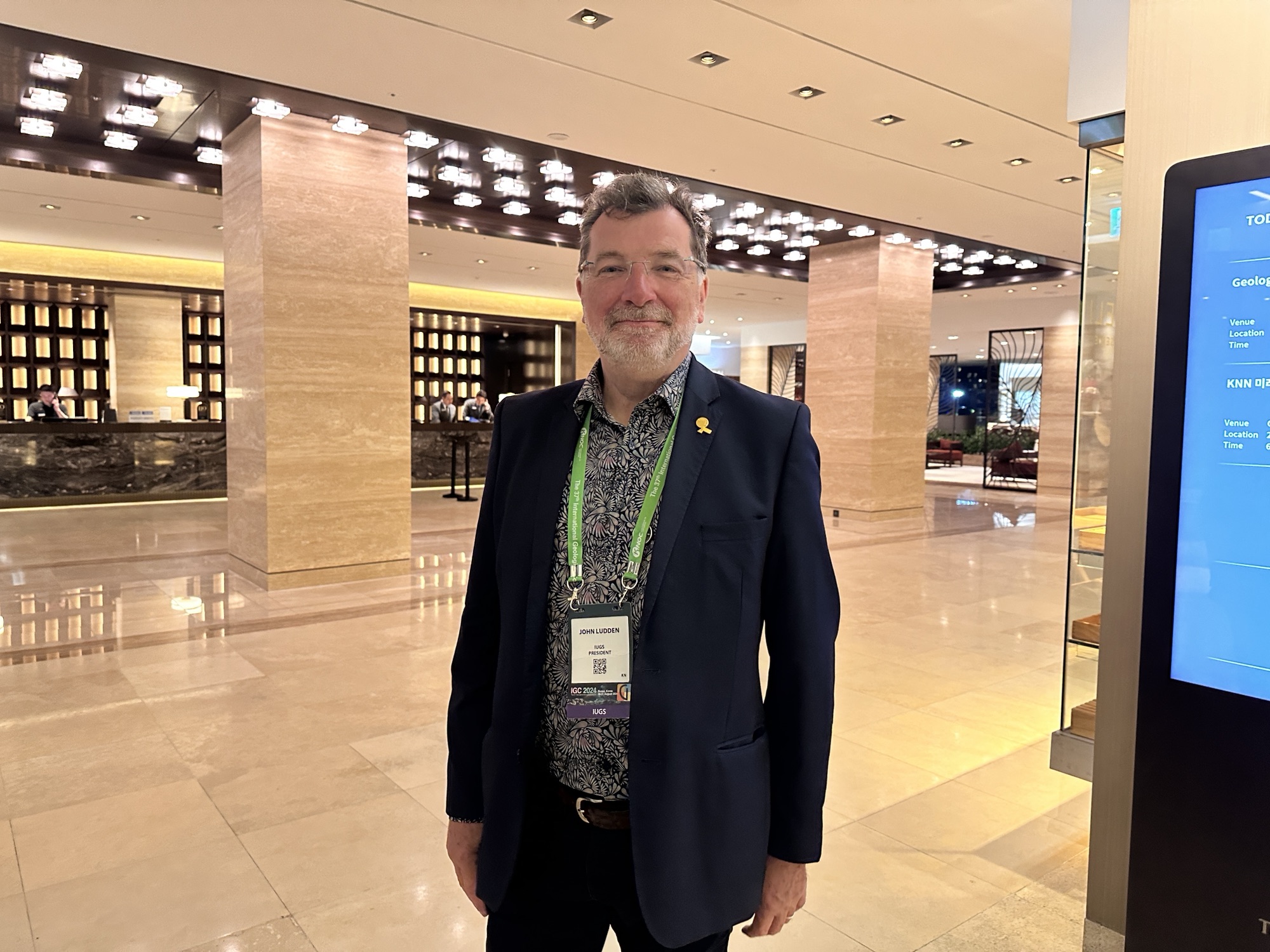
By Wonsuh Song (IGC2024 Organizing committee member)
【Busan, South Korea】 – John Ludden, a distinguished geologist and Chairman of the International Union of Geological Sciences (IUGS), has had a profound impact on the field of geosciences through his leadership, research, and advocacy. With a career spanning decades, including his tenure as Executive Director of the British Geological Survey (BGS), Ludden has been instrumental in bridging the gap between scientific research and policy-making, addressing some of the most pressing global challenges of our time. Fresh fromwonsuh his keynote speech at the 2024 International Geological Congress (IGC) in Busan, South Korea, Ludden shares his insights on the evolving role of geosciences, the importance of interdisciplinary collaboration, and the future of our planet.
Q: John, thank you for joining me today. To start, could you reflect on your recent speech at the 2024 IGC in Busan? What were the main themes you aimed to communicate to the audience?
John: Thank you for the opportunity to speak with you. The 2024 IGC in Busan was a pivotal event, not just because it marked our return to in-person meetings after an eight-year hiatus due to the COVID-19 pandemic, but also because it offered a platform to address the critical issues facing our planet today. In my speech, I wanted to highlight the role of geological sciences in understanding Earth’s processes and in contributing to global sustainability efforts. I spoke about the need for a holistic view of Earth’s systems and urged the geological community to ask themselves, “What Earth do we want to live on?” This question is fundamental as it prompts us to consider whether our current trajectory of economic growth is sustainable or if we need to rethink our relationship with the planet to ensure its long-term health and stability.

Q: Your mention of the Anthropocene era was quite thought-provoking. Why do you believe it is so crucial for both geoscientists and the public to understand this concept?
John: The Anthropocene is a concept that encapsulates the idea that human activity has become a significant geological force, shaping the Earth’s surface and atmosphere in ways that are both profound and measurable. This era represents a departure from the natural processes that have shaped our planet over billions of years, highlighting the extensive impact humans have had, particularly since the Industrial Revolution. For geoscientists, acknowledging the Anthropocene is about recognizing our role in these changes and taking responsibility for the future. For the public, it serves as a call to action, underscoring the need for sustainable practices and greater environmental stewardship. The term has a powerful resonance because it connects scientific understanding with everyday experience and decision-making. It reminds us that the choices we make today will have long-lasting effects on our planet.
Q: Your career has been characterized by a strong focus on integrating science with policy. Can you elaborate on how this experience has influenced your approach as Chairman of the IUGS?
John: My experience at the British Geological Survey was indeed foundational in shaping my approach to leadership at the IUGS. At BGS, we worked hard to ensure that our scientific research was not just cutting-edge but also directly relevant to policy and societal needs. This involved a lot of engagement with policymakers, industry leaders, and other stakeholders to translate scientific findings into practical, actionable policies. At the IUGS, I’ve continued this emphasis on relevance and impact. We aim to set global standards for geological research and ensure that our work supports sustainable development goals. Our focus is on providing a scientific basis for managing natural resources, mitigating natural hazards, and understanding climate change—all of which require a close interface between science and policy.
Q: You’ve highlighted the significant role of technology in advancing geological sciences. How do you see innovations like artificial intelligence and satellite monitoring shaping the future of the field?
John: Technological advancements are revolutionizing geosciences in ways we couldn’t have imagined a few decades ago. Artificial intelligence, for example, allows us to analyze vast amounts of data more efficiently and accurately, leading to better predictive models for natural disasters and environmental changes. Satellite monitoring provides real-time data on a global scale, which is crucial for tracking changes in the Earth’s surface, from glacial melt to deforestation. These technologies are enhancing our ability to understand complex geological processes and to predict future scenarios, which is essential for planning and mitigation efforts. Moving forward, the integration of these technologies will be critical in developing more comprehensive and effective strategies for managing the Earth’s resources and addressing environmental challenges.

Q: You also spoke about the importance of interdisciplinary collaboration. Could you expand on why this is so vital for the future of geosciences and environmental sustainability?
John: Interdisciplinary collaboration is crucial because the challenges we face are inherently complex and interconnected. Geoscientists bring a deep understanding of Earth’s processes, but solving problems like climate change, water scarcity, and resource depletion requires input from a wide range of disciplines. For instance, in managing the subsurface for geothermal energy or carbon capture, we need the expertise of engineers who understand the technological and infrastructural requirements, as well as socioeconomists who can address the economic and social implications. By collaborating across disciplines, we can develop more holistic solutions that are not only scientifically sound but also socially equitable and economically viable.
Q: You’ve been involved in numerous international collaborations throughout your career. How do these collaborations enhance our ability to tackle global challenges?
John: International collaborations are essential because they allow us to pool resources, share knowledge, and develop best practices on a global scale. Geological challenges do not recognize national borders; issues like climate change, natural disasters, and resource management are global in scope and require coordinated efforts. Through international collaborations, we can learn from each other’s experiences, leverage different expertise, and build a more comprehensive understanding of the Earth’s systems. These collaborations also help in standardizing methods and approaches, which is crucial for ensuring that our efforts are effective and comparable across different regions and contexts.
Q: What do you see as the most significant challenges and opportunities for geosciences in the coming years?
John: One of the most pressing challenges is achieving a balance between economic development and environmental sustainability. As populations grow and economies expand, the demand for natural resources increases, putting pressure on the environment. Geoscientists have a critical role to play in ensuring that resource extraction and use are conducted sustainably. At the same time, there are significant opportunities in areas like renewable energy, where geological knowledge can contribute to the development of geothermal energy, carbon capture and storage, and other technologies that support a low-carbon future. There are also exciting frontiers in planetary geology, where we are beginning to explore and understand the resources and potential for human activity on other planets and moons. These developments present both challenges and opportunities for the geoscience community to expand its impact and relevance.
Q: In your view, how can geoscientists effectively communicate their findings and the importance of their work to the broader public and policymakers?
John: Communication is key to the impact of geosciences. We need to convey the relevance of our work in a way that resonates with both the public and policymakers. This means not only presenting our findings clearly and concisely but also framing them in the context of broader societal issues. For instance, when we talk about geological hazards, we should also discuss their implications for communities, economies, and infrastructure. We need to be proactive in engaging with media and using platforms like social media to reach wider audiences. It’s also important to foster relationships with policymakers so that they see geoscientists as valuable partners in decision-making processes. By effectively communicating our work, we can help ensure that geological knowledge is integrated into policies that promote sustainability and resilience.
Q: Finally, as we face a rapidly changing world, what message would you like to impart to the geoscience community?
John: My message to the geoscience community is one of hope and responsibility. We are at a critical juncture in history where the decisions we make today will shape the future of our planet. As geoscientists, we have a unique perspective on the Earth’s processes and a crucial role to play in guiding society towards sustainable practices. We need to continue pushing the boundaries of our research, engaging in interdisciplinary collaboration, and effectively communicating with the public and policymakers. The Earth faces unprecedented challenges, but with our collective knowledge, passion, and commitment, we can help create a sustainable and resilient future for all.
Wonsuh Song: Thank you, John, for sharing your insights and for your unwavering dedication to advancing the field of geosciences. Your work continues to inspire and guide us toward a better understanding and stewardship of our planet.
John Ludden: Thank you. It’s been a pleasure discussing these important topics, and I look forward to continuing this vital work with my colleagues and the broader geoscience community.

Interviewer: Wonsuh Song (Ph.D.)
Organizing committee member of IGC 2024
Leadership Development/Governance Committee member of AGU
Global strategy committee secretary of JpGU
Lecturer, Shumei University, Japan