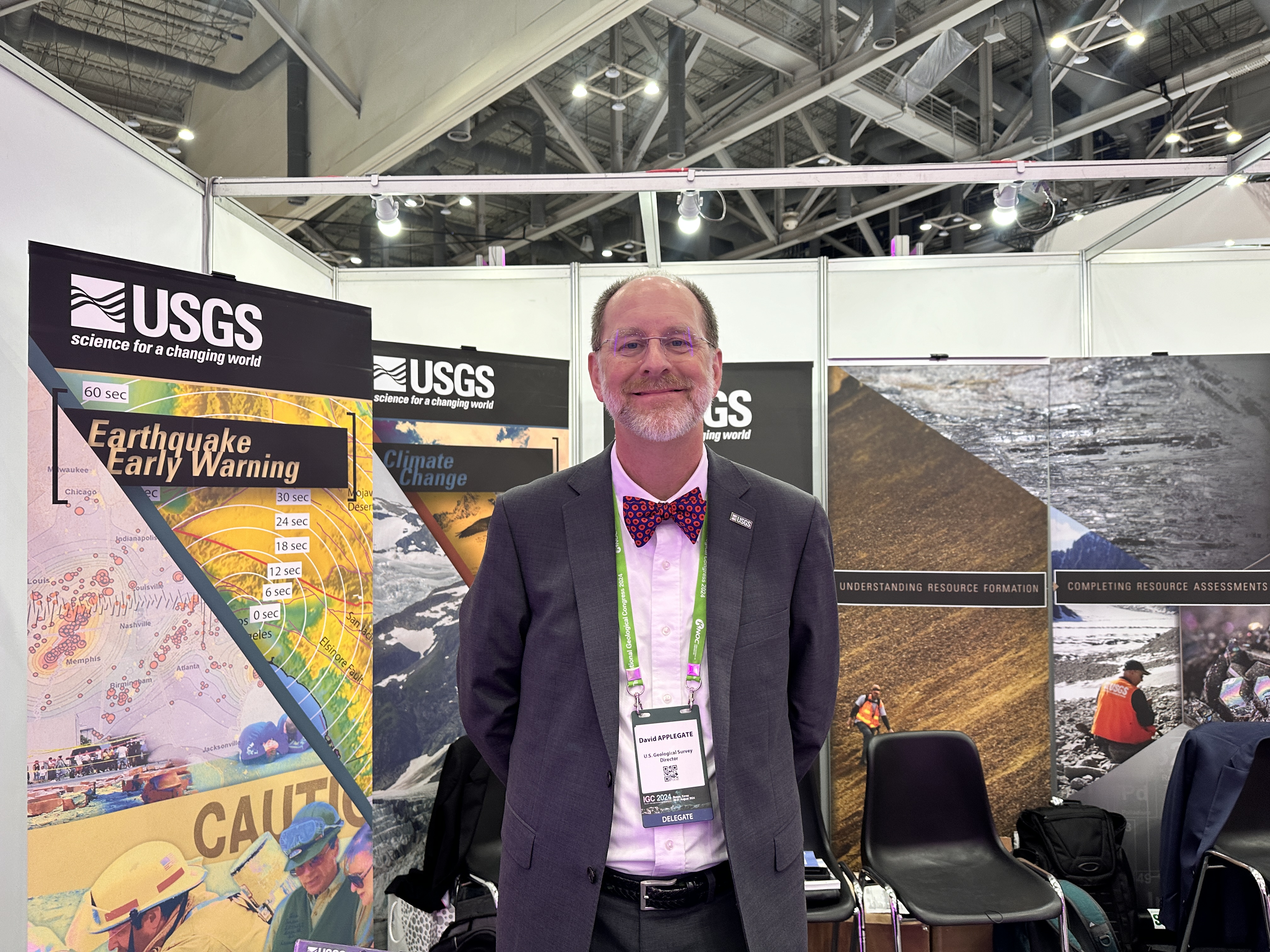
By Wonsuh Song (IGC2024 Organizing committee member)
【Busan, South Korea】 – The 37th International Geological Congress (IGC) 2024 is in full swing, bringing together leading scientists, researchers, and policymakers from around the world. Among the distinguished speakers is Dave Applegate, the Director of the United States Geological Survey (USGS). With a deep commitment to advancing geoscience for public good, Applegate’s presentation at IGC 2024 focused on the critical role of foundational geoscience data collection, mapping, and analysis in shaping U.S. infrastructure policy.
Applegate’s presentation, titled “U.S. Invests in Foundational Geoscience Data Collection, Mapping, and Analysis to Inform Infrastructure Policy,” highlighted the significant investments made by the USGS in recent years, fueled by the Infrastructure Investment and Jobs Act of 2021. These investments are aimed at enhancing programs such as the Earth Mapping Resources Initiative (Earth MRI), the 3D Elevation Program (3DEP), and the National Geological and Geophysical Data Preservation Program (NGGDPP). I sat down with Applegate to discuss these initiatives and their broader implications for geoscience and infrastructure planning.
Interviewer: Wonsuh Song
Q: Director Applegate, it’s great to have you here at IGC 2024. Can you start by giving us an overview of your presentation and the key initiatives that the USGS is currently focusing on?
Applegate: I’m going to be speaking about our efforts to collect foundational Earth science data in support of critical minerals, particularly those needed for clean energy supply chains. We have a project in the US known as the Earth Mapping Resources Initiative, or Earth MRI, where we’re collecting geospatial, geological, geophysical, and geochemical data in areas of the United States that are prospective for critical minerals, including mine waste, with the potential to derive critical minerals from that.
Q: You mentioned the Earth Mapping Resource Initiative (Earth MRI) in your talk. Can you elaborate on what this initiative entails and its importance?
Applegate: We recognize that with changing technology, there are changing needs for the types of minerals that go into technology and infrastructure. It’s important that we understand where those resources are, as well as understand the supply chains and where they may be limited or vulnerable to disruption. The USGS provides this foundational geoscience data, which is available to all to support that need.
Q: One of the unique aspects of Earth MRI that you highlighted is the evaluation of mine waste as a potential resource. Could you explain more about this?
Applegate: With the growing need for a wide range of minerals, there are many cases of historic mining where they may have been looking for one mineral, but other minerals might have been left in the waste. Using new techniques like geophysical surveying, we can identify where there might be concentrations of critical minerals. This could help fund the cleanup of mine waste, creating a win-win situation.
Q: You also talked about the 3D Elevation Program (3DEP). How does this program contribute to infrastructure planning and public safety?
Applegate: Geospatial data is foundational to any infrastructure project. The USGS is in the process of collecting high-resolution topographic data for the entire nation. Along with hazard and resource assessments, this is some of the key data needed for any infrastructure project.

Q: The NGGDPP seems to play a significant role in preserving critical geoscience data. How does this program support the USGS’s mission?
Applegate: The National Geological and Geophysical Data Preservation Program (NGGDPP) enables us to work with state geological surveys to preserve physical, geological, and geophysical data, and make it accessible for a wide range of applications, including the search for critical minerals. Under the Bipartisan Infrastructure Law, the USGS received funding to advance Earth MRI, enhance data preservation, and build a new facility for energy and mineral research to support clean energy supply chains.
Q: Looking ahead, what are the biggest challenges and opportunities you see for the USGS and the broader geoscience community?
Applegate: The opportunity to collect this foundational data is very exciting. The US is still under-mapped in terms of complete coverage of high-resolution topography, geologic mapping, and geophysical or geochemical data. The Bipartisan Infrastructure Law funding is enabling us to make significant progress in expanding coverage. The next step is to analyze the data to identify critical areas and opportunities for development while understanding the trade-offs between development and environmental sensitivity. The more we know about where resources are, the better we can understand where the greatest trade-offs and opportunities lie.

Q: And is this your first time visiting Busan or Korea? What are your impressions of the city and the conference so far?
Applegate: Oh, it’s been an extraordinary experience. I’m so appreciative of Korea for hosting this extraordinary gathering of geoscientists. It is a wonderful opportunity for the USGS to interact with other geological surveys from around the world and to experience the spectacular geologic setting of Busan, especially here on the coast.
Q: Is there anything else you want to add or a message you’d like to convey to the attendees of IGC 2024?
Applegate: I would say that the IGC is a wonderful opportunity for our scientists to learn from their colleagues around the world. We hope that we can share some of our knowledge and experience as well.
Wonsuh Song: Thank you, Mr. Applegate. It’s been a pleasure.
David Applegate is the 18th Director of the U.S. Geological Survey, officially sworn in on August 15, 2022. Before this, he served as the Associate Director for Natural Hazards and led USGS emergency response efforts. He is a fellow of the American Association for the Advancement of Science and the Geological Society of America. Applegate holds a B.S. in geology from Yale and a Ph.D. in geology from MIT.

Interviewer: Wonsuh Song (Ph.D.)
Organizing committee member of IGC 2024
Leadership Development/Governance Committee member of AGU
Global strategy committee secretary of JpGU
Lecturer, Shumei University, Japan